
Some stupid jokes earn a laugh because they are clever. Others earn a groan because the answer was practically waiting on the table. If a lunchbox asks for a lighter workload or a spoon takes the long way around a bowl, nobody needs a complicated setup. This collection is for that second kind of pleasure: clean, goofy questions and small comic scenes you can share with a kid, send to a friend, or slip into a casual conversation. The objects take themselves seriously; you don’t have to. Choose a favorite, deliver the answer once, and let somebody else try to outdo it.
The quickest Q and A jokes
A short question gives the listener a chance to guess. The answer should be easy to understand on the first hearing, even if it is wonderfully unnecessary. These are good opening choices when you do not know whether the audience wants a long routine.
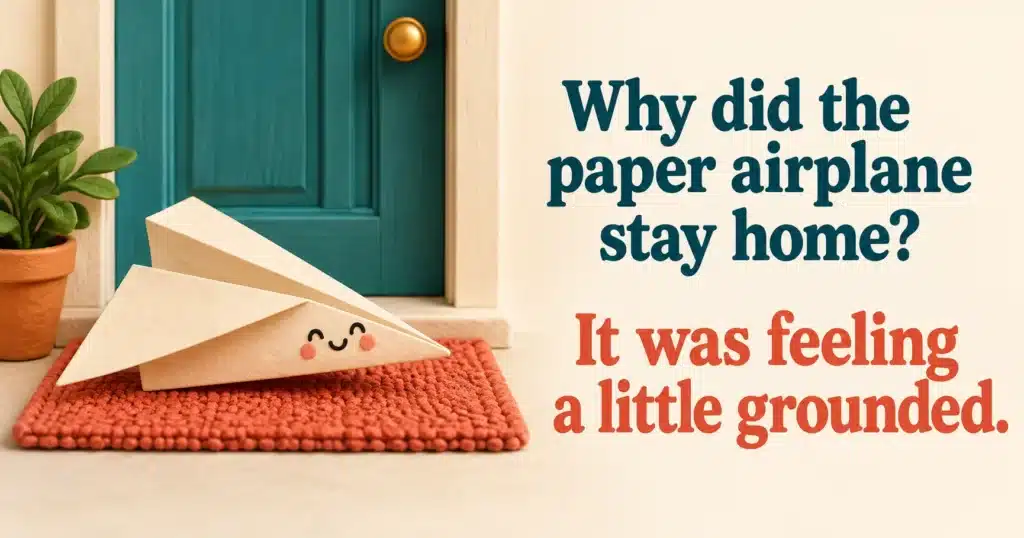
- Why did the paper airplane stay home? It was feeling a little grounded.
- What did the pencil do at the gym? It worked on its point.
- Why did the chair get invited to the picnic? It always brought support.
- What did the suitcase say before vacation? “I am packed with ideas.”
- Why did the faucet join a band? It had a steady drip.
- What did the window call its favorite day? A clear one.
- Why did the doorbell study music? It wanted to improve its tone.
- What did the napkin say to the spilled juice? “I have this covered.”
- Why did the shoelace get nervous? It was tied up in knots.
- What did the doormat ask the guests? “Could you step lightly this time?”
The setup is part of the fun. If you say “A shoelace got nervous,” a listener may imagine a much bigger story, and the tiny answer creates the groan. Do not insert a long explanation between the question and punchline. If you have to unpack the word “grounded” afterward, save the paper-airplane line for someone who knows both meanings and choose a simpler joke for a younger child.
Animals with inconveniently human plans
Animal jokes work when the creature keeps one recognizable trait while trying to manage a human problem. These do not rely on making the animal talk exactly like every other cartoon character.
- The snail joined the track team and asked whether the finish line could come closer.
- A penguin opened a summer shop. The inventory did not survive the heat.
- The squirrel started a savings account and deposited acorns by the handful.
- The turtle bought a planner. It left plenty of time between appointments.
- The goose became a crossing guard and took the job personally.
- The cat signed up for yoga, then occupied the mat for an hour.
- The dog ran for class president on a platform of more recess.
- The goldfish requested a larger apartment with the same water view.
- The rabbit joined a book club and kept hopping ahead to the ending.
- The owl tried a daytime shift. It had several questions about the schedule.
Animal humor can become a parade of predictable “What do you call…” answers. Give each animal a different activity instead: a shop, a savings account, a class election, or a yoga mat. A child can picture those scenes quickly. If a joke depends on a factual animal claim, check it; these are cartoons, and no line needs to pretend to teach zoology.
Food that should not be in charge
Treat a food as a small character with an ambition. The joke can be silly while the food still behaves a little like itself. These are easy to use beside a lunch photo or in a note tucked into a lunchbox.
- The waffle tried to run a meeting, but every idea got stuck in a square.
- The orange became a lifeguard and kept reminding everyone to peel carefully.
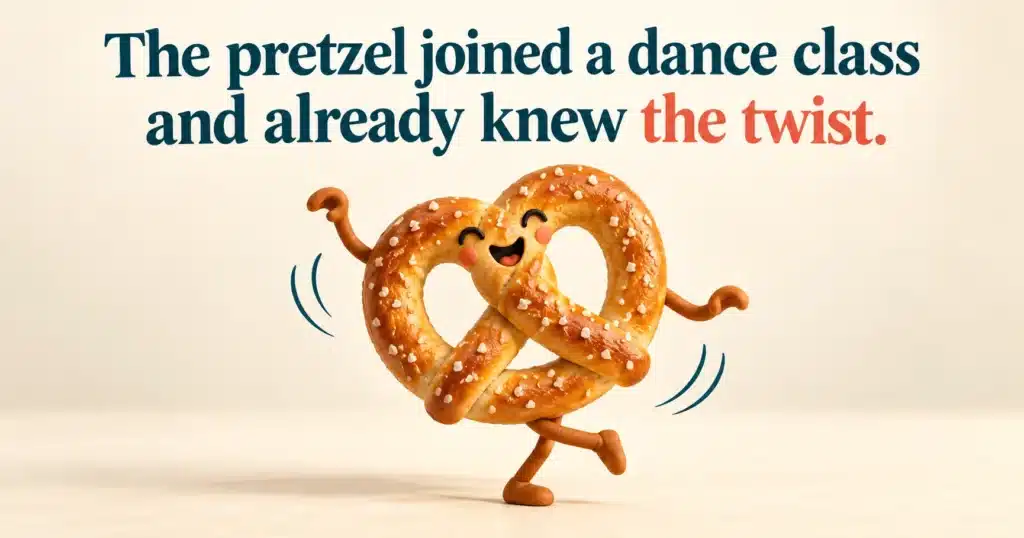
- The pretzel joined a dance class and already knew the twist.
- The jelly started a diary. The entries were a little wobbly.
- The rice asked for more space at dinner; it said the pot was crowded.
- The lettuce founded a club and immediately made a leaf of rules.
- The cheese applied for a theater role. It was ready to melt on cue.
- The pancake took a vacation because it was tired of being flipped.
- The apple entered a talent show and brought a core group of fans.
- The cracker asked for a quiet table; it did not want to crumble under pressure.
Use the food’s actual shape or kitchen role to make the punchline legible. A pretzel can twist; rice can crowd a pot; a cracker can crumble. The silly part is the human situation wrapped around that familiar property. In a caption, the picture can set up the joke. In speech, include enough of the food’s identity that the listener is not left guessing.
Ridiculous misunderstandings
A phrase with two readings lets the joke go wrong in a harmless way. The listener sees what the speaker meant and what the character chose to hear. Keep the mistake small, not dangerous.
- I told the lamp to brighten my day. It turned on and considered its job done.
- The teacher said, “Draw a line.” The pencil asked where it should stand.
- I asked the clock for more time. It moved its hands but offered no help.
- Someone said, “Give the plant room to grow.” I moved it into the hallway.
- I told the vacuum to pick up after itself. It picked up a sock.
- The baker said to “roll with it.” The dough took the advice literally.
- I asked the curtain to open up. It showed me the window.
- The coach said, “Keep your eye on the ball.” I watched it until dinner.
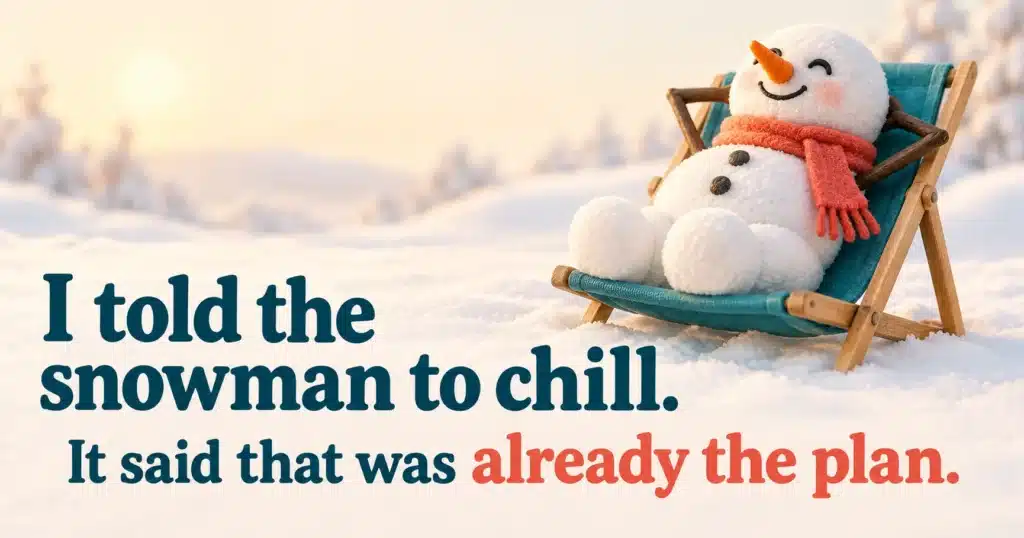
- I told the snowman to chill. It said that was already the plan.
- The mechanic said, “Take a seat.” I asked if I could return it tomorrow.
A literal misunderstanding needs a familiar phrase. If the words have no second reading, the character is just confused and the joke may feel mean. Here, the humor belongs to the language. You can invent more by writing down instructions people say without thinking—“hang in there,” “stay sharp,” “hold that thought”—and asking what a cartoon object would do if it obeyed exactly.
Very bad one-liners for a very short break
No question setup is needed here. Each line introduces a tiny situation and ends before it grows into a story. They suit a quick text, caption, or spoken pause between other activities.
- My ruler asked for a vacation, but it could not find a longer break.
- The calendar and I broke up. We kept setting dates and missing them.
- My garden shovel has a deep interest in local news.
- The lunch tray started a business. It already had several compartments.
- I tried to befriend the fog, but the plan was unclear.
- The trash bag requested a more positive work environment.
- My socks are in a committed relationship with the dryer, apparently.
- The hallway mirror keeps looking into my business.
- My notebook made a promise, but it could not keep a straight line.
- The ceiling fan is great at networking; it knows everybody in the room.
The one-liner has less room for setup, so put a recognizable object near the beginning and a clear turn at the end. If a line needs a footnote, it is no longer a quick joke. Keep the weirdness just a step beyond ordinary reality. A trash bag asking for positivity is absurd, but everyone understands why its job might be unpleasant.
For a road trip with mixed ages
A car ride gives a joke a second life because passengers can invent alternative answers. Use clean words that a child can repeat at the next stop, and let other passengers take turns. Nobody needs to win.
- Why did the map get tired? Everyone kept asking it for directions.
- What did the seat belt say before the trip? “I am attached to this plan.”
- Why did the road sign need a nap? It had been pointing all day.
- What did the tire pack for lunch? A spare roll.
- Why was the gas station so popular? It knew how to keep people going.
- What did the back seat tell the front seat? “Stop making all the decisions.”
- Why did the windshield bring sunglasses? It expected a bright drive.
- What did the highway call its long weekend? A stretch.
- Why did the car radio tell jokes? It wanted to tune up the mood.
- What did the rest stop say? “Take your time; it is in my name.”
A joke about a road sign can land even if nobody has seen that exact sign. A joke about a specific town may exclude half the passengers. Keep the subject common, the answer short, and the timing considerate of the driver. The driver should not be asked to read a phone screen or perform a guessing game during a difficult part of the trip.
Workplace-safe nonsense
The best office joke is about an object or a minor shared inconvenience, not a coworker. These are suitable for a break-room note or a casual team chat when the discussion is already light.
- The printer asked for a promotion. It says it produces results on paper.
- My spreadsheet requested a personal day; the cells need space.
- The stapler is the only one in the office who gets attached immediately.
- The coffee maker called a meeting. Attendance was unusually strong.
- The keyboard says it is tired of being pressed for answers.
- The whiteboard has been keeping a clean record of every bad idea.
- The paper shredder is an excellent listener, but a poor archivist.
- My desk lamp wants a brighter career path.
- The office plant applied for a window seat and got one without a form.
- The sticky notes are organizing themselves, which seems optimistic.
In a workplace, short and optional matters. A joke should not interrupt a deadline or turn a serious team message into a guessing game. Post one line when the conversation has room for it. Avoid jokes about someone’s health, identity, or performance. An object can take the blame for an awkward printer day without putting another person in the spotlight.
So obvious the groan arrives early
Part of a stupid joke’s appeal is that the listener sees the answer coming and waits for you to say it anyway. These give the listener that small, shared win.
- Why did the pillow win the sleep contest? It had been practicing every night.
- What did the umbrella do when it rained? It opened up.
- Why was the ice cube cold? It had never considered another career.
- What did the broom sweep under the rug? A very small secret.
- Why did the clock hurry? It was running out of time.
- What did the book say to the bookmark? “Thanks for keeping my place.”
- Why did the baker knead a break? The dough had a lot to handle.
- What did the chair do when the music stopped? It stayed seated.
- Why did the notebook make a list? It wanted things lined up.
- What did the window do on a sunny day? It let the light in.
Obvious is different from random. A pillow winning a sleep contest has an immediate link; a pillow winning a bicycle race would need another clue. If you can predict the punchline before the last word and still enjoy hearing it, the joke has done its job. Deliver it with a little confidence and do not apologize for it first.
Make a bad joke better by removing the extra sentence
Start with a familiar object and its ordinary action. A stapler fastens papers; a flashlight makes light; a fridge keeps things cold. Give it a small human desire, then connect the desire to the ordinary action. “The flashlight wants a new career because it is good at bright ideas” is more direct than a three-sentence story about its interview, commute, and manager. Cut the detour unless the detour earns a second surprise.
Another method is to write the expected answer and then choose a different but still connected one. If you ask why a clock is stressed, “It is running out of time” is the first idea most people have. You could change the situation: a clock acting as a referee might be tired of everyone asking for extra time. That version has a scene. It also risks being longer, so read it aloud and decide whether the extra words help.
Test a joke by covering the punchline. Can someone guess a few plausible answers from the setup? If not, the setup may be too vague. Now reveal the punchline. Does it connect to something in the setup without needing a lecture? If not, revise the link. A deliberately dumb joke still respects the listener’s time. The groan is a reward for understanding, not a punishment for failing to follow the logic.
Build a joke from an ordinary object
Take a flashlight. It has a beam, a switch, and batteries. The first draft might be “The flashlight was bright.” That is a description, not a joke. Give it a human situation: a job interview. “The flashlight applied for a job because it could bring a bright idea to the team” has a pun but also sounds like a familiar greeting-card line. A fresher turn might be, “The flashlight asked to work the night shift. It said that was when its ideas showed up.” The object’s actual use makes the strange career choice understandable.
Try a lunchbox. It carries food, has a lid, and gets opened halfway through the day. If you make it “hungry,” the joke is too generic; every food object can be hungry. If you make it overprotective of the sandwich, it acquires a specific character: “The lunchbox refused to share its plans until noon.” That line may still need a stronger payoff, but it points toward the right kind of scene. Ask what a lunchbox could misunderstand about “keeping a lid on things” or “packing it in.” Choose one connection and keep the sentence short.
A doormat offers a different set of meanings: welcome, entrance, shoes, being walked over. “The doormat started a boundary workshop” may be funny to an adult but less clear to a child. “The doormat asked visitors to wipe their feet somewhere else for once” is visual and direct. Neither is the only answer. The useful exercise is to list the object’s actual job, choose a small human complaint, and let the last phrase join them.
The editing stage matters. If two jokes in your list both feature objects asking for promotions, keep the better one. If five end with “under pressure,” vary the mechanism. You can use sound (“roll” and a bread roll), double meaning (“date” and a calendar), a literal instruction (“draw the curtain”), or a small absurd character choice. A collection feels more entertaining when the reader cannot predict the form of the next line.
Match the joke to how it will be heard
A spoken joke needs words that sound distinct. “The pretzel already knew the twist” is easy to catch aloud. A spelling-only pun may vanish when heard, and the listener cannot see the letters you changed. If you are telling a Q&A joke to a child, give them time to guess. They may produce a better punchline, and that is part of the fun. Let them retell the line in their own words instead of correcting every syllable.
A text joke can use a question mark and a line break to create timing, but it still needs to be understandable without your expression. If the recipient has to ask “Who is the stapler?” the setup is incomplete. In a group chat, choose one joke that relates to the conversation. A random list of ten can bury the punchline and crowd out other people. A joke about the printer fits a conversation about a printer. A joke about a turtle’s planner may be better saved for a child who likes animals.
A caption is even more dependent on context. A photo of a lunch tray can make “several compartments” visual. Beneath a sunset, that joke feels pasted on. Write the caption after looking at the image, not before. The photograph does some setup work, so the line can be shorter. Avoid piling on a second explanation, three emojis, and a hashtag that restates the pun. Let the reader make the connection.
A road-trip joke has its own rules. The driver should be able to hear it without looking away from the road. Passengers can take turns with short questions and answers, but do not distract the driver in traffic or during navigation. A familiar animal or food setup can bring different ages into the game. If an adult wants to tell a longer joke, wait for a calm stretch or a rest stop.
The lunchbox’s questionable comedy club
These deliberately goofy Q&As give ordinary objects a tiny ambition. The point is the groan you can share with a kid, a friend, or a coworker on a slow afternoon.
- Why did the sandwich ask for privacy? It was feeling pressed.
- What did the orange say to the lunchbox? “Thanks for peeling back the lid.”
- Why did the water bottle join the choir? It could carry a tune in every sip.
- What did the napkin do after the joke? It folded with laughter.
- Why did the apple bring a map? It didn’t want to get lost in the fruit bowl.
- What did the cookie say to the crumbs? “Stay close; we’re a team.”
- Why was the spoon late? It took a long route around the bowl.
- What did the backpack order? A lighter workload.
- Why did the pencil sit with lunch? It wanted to draw a crowd.
- What did the sandwich tell the bread? “I think we’re in this together.”
- Why did the banana avoid an argument? It didn’t want to slip up.
- What did the lunch bell promise? “I’ll call when it’s time.”
- Why did the thermos refuse to gossip? It knew how to keep things inside.
- What did the carrot bring to the meeting? A root of the problem.
- Why did the tray stay calm? It had everything under control.
- What did the zipper say to the backpack? “Let’s keep this together.”
- Why did the cracker start a band? It had a crisp sound.
- What did the juice box say after a long day? “I’m drained.”
- Why did the fork sit up straight? It wanted to make a good point.
- What did the lunchbox say to the empty table? “We can make room.”
A lunch note only needs one. Choose the joke that matches what the child actually packed, add a plain good-luck message, and let them decide whether to share it. The note should feel like it came from a person, not a joke dispenser.
Turn one household mishap into a clean Q&A
Suppose the kitchen timer rings while nobody remembers what it was timing. Write down the plain scene first. Then imagine what the timer believes it accomplished. It might be proud of getting everyone’s attention, even if the meal is still a mystery. A question can hold back that point: “Why did the kitchen timer feel successful?” The answer can be “Everybody came running, and it never promised to remember dinner.”
The sentence can be improved by reading it aloud. If the answer is too long to hear in one breath, shorten it: “It got everyone to show up.” That version loses some specificity, so you might instead change the question to mention the forgotten meal. Editing is a tradeoff between clarity and surprise. Try both versions on someone who was not there and see which picture appears fastest.
A silly Q&A collection benefits from different sources of surprise. One joke may use a literal reading, another a stubborn object, another an absurdly earnest answer. If each question begins “Why did the…” and every answer says the object was “tired,” the jokes blur together. Vary the setting and the relationship between question and answer. The kitchen timer, an umbrella, and a lost sock should not all have the same personality.
Use a child-friendly subject without talking down to a child. A simple object and a clear turn give them room to guess. If they offer a different punchline, treat it as a contribution. The best silly-joke moment may be the answer they invent, not the one you planned to read.
When writing for a mixed-age group, ask whether a younger listener can picture the subject and whether an adult can enjoy the turn without needing a private reference. An umbrella, lunchbox, or clock usually works better than a celebrity or a dated internet trend. A silly joke can be uncomplicated without being careless. Give it a clear setup, make one surprising connection, and stop before explaining the connection. If the child supplies a different answer, the exchange may be funnier than your planned punchline. Let the joke become a conversation rather than a test of the printed line.
For a joke card, pair one Q&A with a small drawing of its object. A child can guess the answer before flipping it over, while an adult can enjoy the intentionally silly turn. That format gives the joke a place to live and invites another person to participate. The card does not need a dozen lines to be fun.
Frequently asked questions
What are some good stupid jokes?
The best ones are short, clean, and easy to retell, such as a simple question about an everyday object with an obvious wordplay answer. The joke should make sense after the groan. Pick a topic the listener recognizes—food, school supplies, pets, or a road trip—rather than a reference that needs explaining.
Are stupid jokes the same as anti-jokes?
Not always. A stupid joke often has a pun or an intentionally obvious twist. An anti-joke rejects the expected punchline and answers literally. The two styles can sit beside each other in a collection, but a page made of only one repeated mechanism becomes predictable.
How do I make a joke safe for work?
Keep the target on an object, a harmless situation, or your own minor inconvenience. Avoid coworkers’ identities, health, ability, or job performance. Use a short line in a casual moment and let it go if the chat moves on.
Which jokes work for young kids?
Choose tangible subjects and a brief answer: a pillow, kite, lunchbox, or animal. Kids may retell a line with new wording, so a simple visual connection helps. Invite them to invent their own answer without insisting on yours.
Why are bad jokes funny?
The audience can often anticipate the small pun before the teller says it. The shared recognition, confident delivery, and affectionate groan become part of the fun. A bad joke is less satisfying if the link is random or if it makes a person the target.
How many one-liners should I put in a caption?
Usually one. The picture should provide the context, and the line should carry its own turn. A stack of puns in one caption makes each one harder to notice. Save the others for different posts or the group chat.
Can I change the wording of a joke?
Yes. Make it sound natural in your own voice, but do more than swap a noun in a familiar line if you are publishing it as original. Change the situation, the character’s goal, and the payoff. Read it aloud to see whether the turn arrives at the right moment.
What if nobody laughs?
Move on. The listener may be busy, may not enjoy puns, or may simply have heard that mechanic before. Do not explain the punchline unless someone asks. Another category or a normal conversation may fit better than trying the same joke again.
Let the joke be silly without making someone the fool
A clean stupid joke creates a low-stakes reason to share a groan. It can fit a lunchbox, road trip, break room, or group chat because the target is an object or an everyday absurdity. Choose one that makes sense to the person hearing it, keep the setup short, and say the punchline with a straight face. If somebody adds a worse answer, let the joke become a game. That is more fun than insisting your version was the clever one.

