
A good fish at the aquarium glass can look like a receptionist. One hiding behind a plant could be the most private resident in the building. That small observed behavior does more for a pun than dropping ‘fin’ into an unrelated sentence. These clean fish puns cover aquarium photos, fishing days, cards, and texts, with different lines for each setting. They are playful inventions, not claims about what an animal thinks. Look at the fish, the water, and the people in the scene before picking a caption; the most memorable line usually starts with a detail that was already there.
Aquarium captions for the fish in the frame
A tank photo does not need a fishing joke. These lines lean on swimming, glass, bubbles, color, and the curious habit of watching fish watch back.
- The aquarium residents have requested more window visitors.
- This school has the best attendance record in town.
- My plans are on pause while this fish finishes its lap.
- The bubble schedule is busier than mine.
- I came for the colors and stayed for the tiny staring contest.
- Every lap around the tank is a new tour of the same neighborhood.
- This fish has perfected the art of leaving without going anywhere.
- The tank’s most important meeting is happening behind a rock.
- I asked the fish for directions; it circled back to the beginning.
- Today’s mood is quietly swimming past the noise.
A caption about an aquarium should not imply facts you do not know about the species or its care. Make the joke about your observation. A visible bubble can support a bubble line; a school of fish can support the school pun. One short caption lets the color and motion of the photo do the rest.
Fishing-trip wordplay that stays in its lane
These lines fit a rod, reel, boat, shore, or long wait. They are about the experience, not a claim that anyone caught a record fish.
- I came for a catch and found a very good place to wait.
- The reel and I are taking this relationship one turn at a time.
- My fishing plan has a lot of line and very few guarantees.
- The lake gave me a view and kept the punchline.
- I am hooked on the quiet even when the fish disagree.
- The bait and I have different opinions about today’s odds.
- My best catch so far is a story about the one that left.
- The boat says the day is going swimmingly; I remain cautious.
- The fish are practicing excellent boundary setting today.
- I cast a line and reeled in a reason to stay longer.
Fishing captions can become a row of identical “hooked” lines. Keep one, then use waiting, reeling, a view, or a story for the rest. If the photo shows a catch, respect local rules and the people involved; the caption need not make a factual claim about size or species unless you know it.
Fins, scales, and tails with a second meaning
Fish anatomy gives you words that already do other jobs. “Scale” can refer to measurement or music; “fin” can sound like an ending. Use one move per line.
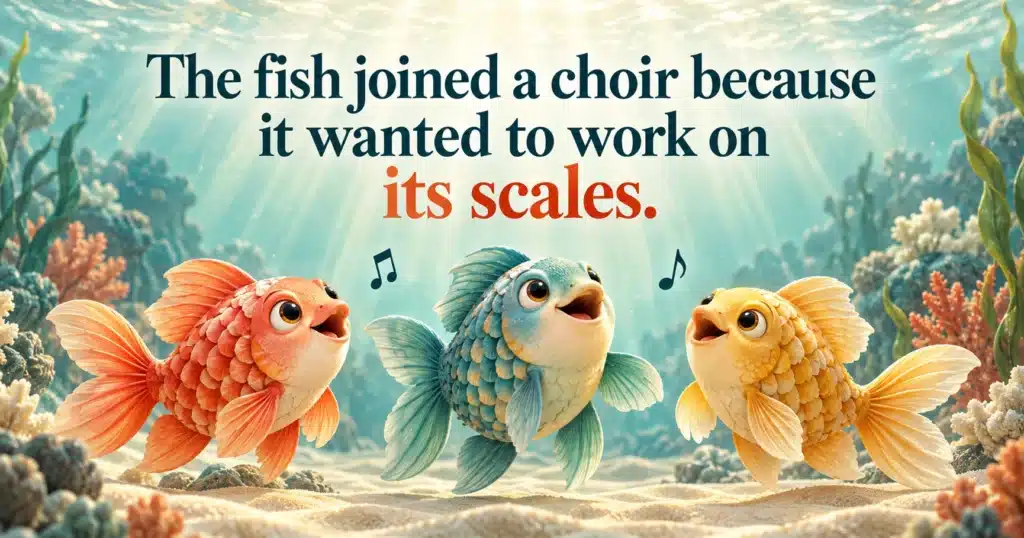
- The fish joined a choir because it wanted to work on its scales.
- My story has a tail, but the fish insists it is the ending.
- The tiny fish requested a larger role and a smaller pond.
- The fin offered a wave and immediately backed away.
- The aquarium band is still tuning its scales.
- The fish said it was done, then added one more fin-al thought.
- That tail is doing all the expressive work in this portrait.
- I gave the fish a compliment; it took it with a little wave.
- The scales made a strong case for better lighting.
- The fish wrote a memoir with a very long tail end.
Written “fin-al” wordplay is easier to see than hear. In a spoken joke, a line about musical scales is clearer. If your pun only works after changing spelling, save it for a sign or caption and keep the rest of the sentence easy to read.
Silly fish questions for kids
Kids can guess before the answer. These are short, clean, and based on a visible behavior or familiar word rather than complicated marine vocabulary.
- Why did the little fish carry a backpack? It was going to school.
- What did the fish say after swimming in a circle? “I know this place.”
- Why did the fish bring a pencil? It wanted to draw a new current.
- What did the fish tell the bubble? “You are going places.”
- Why did the fish take a nap behind the rock? It liked a quiet corner.
- What did the fin say at the end of the story? “That is my final wave.”
- Why did the fish join the band? It had practiced its scales.
- What did the fish say to the aquarium visitor? “Nice to see you again.”
- Why did the fish bring a map? It kept taking the same lap.
- What did the fish call a good day? One with room to swim.
Some lines are simple observations rather than explosive punchlines. That is fine for a child who enjoys answering a question. Encourage them to invent a new fish reply. If they say something funnier than the printed answer, use theirs. A joke list is a starting point for play, not a test.
Birthday-card fish puns with a real wish
A card needs a greeting beneath the wordplay. These lines can accompany a drawing of a fish or a fishing-trip photo.
- Hope your birthday makes a splash in all the right ways.
- Wishing you a day with plenty of room to go your own way.
- I hope the year ahead has good company on every shore.
- You are the friend I would happily spend a slow day fishing with.
- May your plans go swimmingly and your cake arrive on time.
- I am hooked on celebrating with you again this year.
- Here is to more stories worth telling after we reel in the day.
- Hope your birthday brings an ocean of good small moments.
- You deserve a little time to float and a lot of good laughter.
- Let us cast around for a day to celebrate together soon.
A fish pun can suit someone who keeps an aquarium or loves a fishing trip, but it should not replace the personal part of a card. Add one memory or plan you share. “Let’s go back to the lake in spring” makes the closing line more specific than another generic splash wish.
Ocean and shore lines that do not pretend every fish is the same
These use the setting around fish: waves, tides, boats, docks, and water. Match the line to a beach or lake image rather than a tank close-up.
- The tide has a schedule; I am trying not to take it personally.
- The dock and I are both here for the view.
- I waved at the water, and it sent several back.
- My beach plans have been approved by the horizon.
- The lake is keeping the best stories below the surface.
- The boat took the scenic route and called it research.
- I asked the shore for a minute; it gave me a whole afternoon.
- The waves are arriving in groups without a reservation.
- I am taking the long way back from the water.
- The view has me reeling, and the fish did not even try.
Some are water captions more than fish puns, so use them only when the setting is visible. An article about fish can acknowledge that distinction. A fish photograph deserves fish-specific wording; a sunset over water may be better served by a line about the shore. Relevance is more useful than adding another “fin” syllable to every caption.
Quick texts for a friend who loves the water
A pun sent privately can be more specific than a public caption. Mention a planned outing or a shared photo so it does not feel like a forwarded list.
- I found a place for our next fishing day; the fish have not been consulted.
- Your aquarium photo has inspired my afternoon’s main activity: staring.
- I hope work lets you swim out of the inbox early today.
- The lake looked good this morning. We should compare notes soon.
- I saved the best fish story for our next coffee.
- Our next trip needs a dock, snacks, and your most ambitious cast.
- I am rooting for a quiet afternoon and a cooperative reel.
- The fish in your photo appears to have better weekend plans than I do.
- I think we are due for another shore-side conversation.
- This message is a friendly reminder that we owe the water a visit.
A text is best when it opens a real conversation. If the friend responds about their day rather than the joke, follow them. The water pun is a small invitation, not a demand that they reply with another one. Keep it to a single line and let the personal detail do the work.
Work-safe fish wordplay
A casual office chat may have room for a harmless aquatic image. These are not substitutes for clear project information, and they should not turn a colleague into the fish.
- Our team has plenty of ideas in the tank today.
- I am trying to keep the meeting on the same current.
- The spreadsheet is asking for a deeper dive; I am bringing a coffee.
- Let us reel this task in before lunch.
- The printer has gone off the deep end again.
- I am fishing for a better name for this file.
- The whiteboard is full of ideas and one very small doodle of a fish.
- The project has a lot of moving parts; at least none need gills.
- The inbox is a pond, and I am looking for the right thread.
- Let us keep the plan afloat while the details settle.
A pun in a work message should never hide an action item. Put the deadline, owner, and decision in plain language. If you add a joke, place it after the information, or choose a casual channel. A line about a “deeper dive” is familiar business language; a fresh scene may be funnier, but clarity comes first.
Find a better fish pun by changing the setting
List the words you have to work with: fish, school, scales, fin, tail, hook, line, reel, cast, tank, current, tide, wave, dock, and shore. They do not all belong to the same scene. A goldfish in a tank has no reason to hold a fishing rod. A person on a boat may not see coral. Choose the actual image or use case before choosing the word.
Next, identify the double meaning. “School” is a group of fish and a place for students; “scale” is a fish covering and a musical sequence; “line” is fishing equipment or a sentence. Build a brief situation around one connection. “The fish joined a choir to practice its scales” is clear but familiar in structure. Change the relationship or point of view rather than just replacing “choir” with “band.” A fish auditioning for a solo because it is tired of the school might produce another angle.
Do a spoken test. “Fin-al” depends on its altered spelling; in conversation, the listener may hear only “final.” A line about musical scales travels more reliably. For a social caption, a visual spelling pun can work if it is readable on a phone screen. If you have to capitalize random letters to explain it, simplify.
Finally, scan for repeated moves. Ten lines that all say “hooked on” will feel less clever than one. Keep the best hook line, then use a quiet fishing wait, a school-of-fish misunderstanding, an aquarium observation, and a shore image. A varied list helps a reader find a joke that actually fits their photograph or card.
The fish in the scene determines the joke
A fish pun can mean very different things in an aquarium photo, a fishing-trip message, or a birthday card. An aquarium caption can describe movement, hiding, or the color of the fish in the frame. A fishing-trip joke can address the long wait, a tangled line, or a story that grows in the telling. A birthday card has to wish a person well. If you paste the same “fin-tastic” line into all three, it begins to feel like a keyword exercise rather than a message.
Start with what the audience knows. A friend who has watched your aquarium fish hide behind the same plant may enjoy a joke about its favorite private office. A wider audience cannot see that habit in one still photo; a caption can mention the plant. A child may enjoy a fish answering a simple question, but an adult reading a nature journal may prefer a quiet observation. One line does not need to serve everyone.
Use real context without turning the pun into a factual claim. Many online fish jokes treat every ocean creature as a fish or jumble together habitat details. For a light pun, you do not need to teach taxonomy, but a visible goldfish should not be described as a deep-sea traveler. A photo of a school of fish gives you “school”; a solo fish does not. The closer the line stays to the picture, the less it needs to explain itself.
If the message is about a difficult fishing day, keep the humor voluntary. A friend may want to tell the story of the weather, the boat, or the fish that got away. A joke about patience can follow their story, not interrupt it. If the event involved an accident, practical help and concern come first. Wordplay belongs to the easy moments.
Move beyond the familiar spelling swap
“Fin” is useful because it sounds like the beginning of familiar words, but a page filled with fin substitutions becomes predictable. Fish vocabulary includes scales, schools, currents, lines, hooks, reefs, tanks, bubbles, and tides. Each can carry a different double meaning. A “school” can raise a classroom question; “current” can point to water and the present; a line can be a fishing line or a spoken line. Choose one connection and give it a small scene.
Suppose an aquarium fish always swims to the glass when someone enters. A flat caption is “This fish is friendly.” A playful version imagines it as a receptionist checking arrivals. The humor comes from the observed behavior. You could use the word “current” instead, but only if the sentence naturally needs it. The fish itself should remain more interesting than the spelling trick.
For a fishing trip, write the true sentence first: “We waited all morning and caught nothing.” Possible comic angles include the fish declining the invitation, the tackle box getting the most exercise, or the photographer having the better catch. These are not interchangeable. If the group took a beautiful sunrise photo, the photography angle has a second layer. A good pun grows out of the particular day, not a generic claim that the fish were shy.
A birthday card needs a wish. Write “I hope your day is full of the things you love” and then find a gentle water-related line to accompany it. The pun can be a small flourish at the end, but the recipient should still understand why you wrote. Avoid a complicated chain of fish words that demands attention without saying anything affectionate.
Edit for sound, spelling, and audience
Read the line aloud without looking at the page. A joke that works only because “sole” and “soul” are spelled differently may need a visual setting. In a text or on a card, the written form is available; on a boat, the listener hears only one word. You can still use a sound-alike, but the context must make both meanings available. If the listener needs to see your phone afterward, the spoken version has not landed.
Check whether the line names the right subject. “Fish,” “whale,” “crab,” and “dolphin” are not interchangeable images, even if a pun collection puts them on the same page. For a public caption, choose vocabulary that fits the pictured animal. It is possible to be lighthearted and accurate at once. A species-specific detail can make an ordinary wordplay idea fresh.
Finally, remove the line that explains the joke. “The fish is the school principal because groups of fish are called schools” is a setup plus a lesson. “Our aquarium’s principal called a meeting at the glass” allows the audience to hear the connection. If that feels too obscure, give the scene one more concrete clue rather than adding a definition. Humor rewards the reader for connecting the dots.
Three settings, three different fish jokes
At an aquarium, you have a glass wall, a specific fish, and a small observed behavior. If one fish repeatedly patrols the front, imagine it inspecting the visitors. The joke belongs to that fish. A broad line about the ocean would ignore the best detail. A caption can add the observation first: “Every time I walk past, this one checks my credentials.” It invites a second look at the photo.
On a fishing trip, the wait may be the shared memory. A joke about a tackle box getting the most exercise can be affectionate when everyone enjoyed the morning, even without a catch. If someone spent money and effort on a difficult outing, read the room before making their disappointment the punchline. A sunrise, a tangled line, or a snack break offers a safer subject. Let the person who was there tell the story before supplying your line.
In a birthday card, the recipient is the point. A fish pun can refer to a favorite aquarium or beach visit, but it should not be the entire message. “I hope we get another afternoon by the water” gives the note a real wish. A light line about making waves can follow, provided it fits their personality. The same pun that works under a photo may feel generic in a card without that personal sentence.
Fish with jobs they never applied for
An aquarium gives each fish a little stage. These lines imagine their workday without claiming to know what the animals are thinking.
- The fish at the glass has appointed itself visitor services manager.
- That striped fish is conducting a very slow inspection of the plants.
- The shy one has booked the castle for a private meeting.
- The aquarium’s busiest commuter has traveled three feet and back.
- This fish handles complaints by swimming into the cave.
- The bubble maker has a bigger audience than the feeding schedule.
- The little swimmer keeps checking whether the window is still there.
- The fish in front wants a word with whoever cleaned the glass.
- Our tank’s night shift begins when the room lights dim.
- The castle has a resident who takes security very seriously.
- The smallest fish manages traffic by changing lanes constantly.
- The plants offer excellent cover for an imaginary spy.
- This one has a standing appointment with the corner of the tank.
- The fish behind the rock is working from home today.
- The aquarium’s tour guide refuses to leave the front window.
- The slow lap is part of a very thorough patrol.
- The new decoration has passed the first inspection.
- The school held a meeting and invited everyone except the snail.
- That fish is swimming like it has an urgent message and nowhere to send it.
- The best view in the room belongs to the fish looking back at us.
If a particular fish is visible, mention its actual color or behavior. A caption about a cave-dweller will look odd beneath a picture of a fish at the glass. The scene makes the pun feel personal.
Fishing photos deserve a different voice from aquarium photos. One shows the wait, the weather, and the people who came along; the other may show a single fish circling a familiar corner. A caption about a “school” can be clever, but it is less useful than naming the actual scene. Perhaps the tackle box got opened twenty times without a catch, or a fish returned to the glass just as the camera appeared. You can turn either into a joke without pretending the trip was something it was not. The quiet details usually outlast the easy sound-alike.
A birthday card can borrow a real, specific, fond memory of water without turning the recipient into a fish. Mention the aquarium visit, the boat ride, or the walk along the shore, then add a small line if the friend enjoys puns. If the note is only wordplay, it may sound like a generic greeting; a true sentence about what you enjoyed together gives it a reason to be kept long after the birthday celebration itself has ended.
One aquarium photo can support more than one reading. A fish near the front glass might be curious, in a hurry, or simply following its usual path. A caption can play with one of those ideas without pretending it is a fact about the animal. If the picture shows an entire group, let the group be the subject. If it shows one brightly colored fish, let that fish have the starring role. The detail gives the joke somewhere to land.
Frequently asked questions
What is a good fish pun?
A good fish pun makes two meanings clear with little effort. A school of fish can connect to school, and a fish’s scales can connect to music. The line should also match the setting; fishing wordplay may not fit an aquarium photo.
What are short fish captions?
Short captions use one visible clue, such as a fin, tank, wave, or fishing reel. Keep the line readable without a long setup and let the photo supply context. A caption about a catch should not claim a species or size you have not verified.
Are fish puns good for kids?
Yes, when the wordplay uses familiar objects and short questions. A child can guess why a fish brought a backpack or joined a band. Let them offer another answer rather than treating the printed punchline as the only correct one.
Can I use a fish pun in a birthday card?
Yes, especially if the recipient likes fishing, aquariums, or ocean imagery. Add a real wish or memory so the card is more than a string of fish sounds. A short pun works well as a closer after the personal message.
What fish words make useful puns?
School, scales, fin, tail, hook, line, reel, current, and wave all offer possible second meanings or familiar expressions. Choose one that fits the situation. Do not put several in one sentence merely to make it sound more punny.
What if a fish pun needs special spelling?
Use it in a caption or printed card where the reader can see the spelling. Spoken jokes work better with a double meaning that can be heard naturally. If an altered word takes effort to decode, another version may be stronger.
Are fishing puns and aquarium puns the same?
They overlap, but the visible details differ. A rod and reel support “hook” or “line”; a tank supports bubbles, laps, and a school of fish. Matching the joke to the scene makes it feel chosen rather than pasted on.
How do I write an original fish joke?
Start with a real scene, pick one word with a second meaning, and give the fish or person a small goal. Keep the punchline short. If your line sounds like a classic you remember, change the scene and the turn, not just one adjective.
Let the scene do half the work
A fish pun is easiest to enjoy when the fish or water is actually part of the moment. Use an aquarium line for a tank photo, a reel line for a fishing trip, and a gentle wish for a card. Keep the wordplay to one clear turn and leave space for the recipient’s real message. If you are inventing your own, start with the specific fish, place, or person you are writing about. That detail can make a familiar double meaning feel new.

