
A one-liner has no room to hide a slow setup. ‘My bookmark has excellent boundaries; it knows exactly where I stopped’ gives you the object, the turn, and the ending in one breath. This collection of clean puns moves through food, home, books, travel, work, and small everyday mishaps. Some belong beneath a photo; some survive on their own in a text. Read a favorite out loud before sending it. If the double meaning only appears in the spelling, save that one for a caption or card and choose a clearer line for conversation.
Food lines with a clear twist
The best food pun stays close to the food’s shape, preparation, or place on the table. These do not require a five-sentence menu description.
- The bagel has a hole in its plan but insists breakfast is still on track.
- My soup asked for a quiet evening; it was already simmering.
- The pretzel joined a debate and tied itself in knots.
- The cookie took criticism hard and crumbled at the first comment.
- The muffin got a warm reception before anyone knew its name.
- My toast has a point, but it is a little burned around the edges.
- The rice brought the whole group to dinner, one grain at a time.
- The olive asked for a place in the conversation and got the pit seat.
- My sandwich wants boundaries after another pressing day.
- The pancake keeps flipping its opinion on breakfast.
Food captions can lean on a photo; spoken lines need a subject the listener can picture. “The pretzel tied itself in knots” works without a picture. A highly specific plating joke may not. Use the food that is actually present if the line is meant for a menu or social post.
Household objects with office ambitions
These objects have a job already, so giving them another job creates the absurdity. Keep each character’s personality different rather than having every object ask for a promotion.
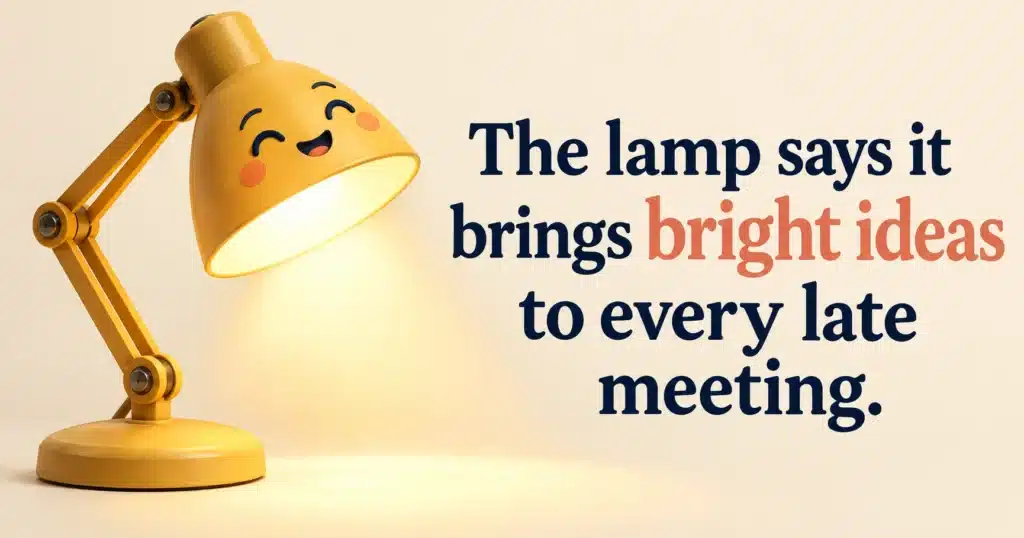
- The lamp says it brings bright ideas to every late meeting.
- My broom has a clean record and a messy workload.
- The rug has been walked over and would like a word with management.
- The fridge keeps its cool even during the busiest dinner rush.
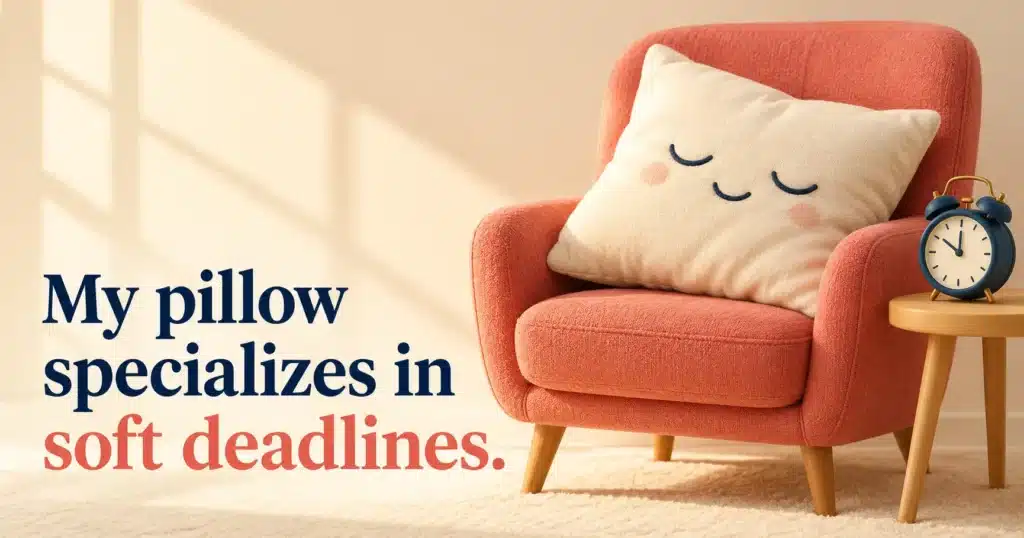
- My pillow specializes in soft deadlines.
- The window wants a clearer role in the house.
- The remote has control issues it refuses to discuss.
- The kettle reaches its boiling point at the same time every morning.
- The laundry basket has a full agenda and no assistant.
- My clock has excellent hands but terrible boundaries around overtime.
One-liners about objects are clean and flexible. A photo of the kettle can support the boiling-point joke, and an office chat can use the lamp line. The object should not be a disguise for insulting a person. A joke about the printer’s mood is safer than one about the colleague who fixed it.
Books, pencils, and other paper trails
School and reading vocabulary offers pages, lines, points, margins, and chapters. Each line uses one connection so the reader does not have to solve a paragraph of wordplay.
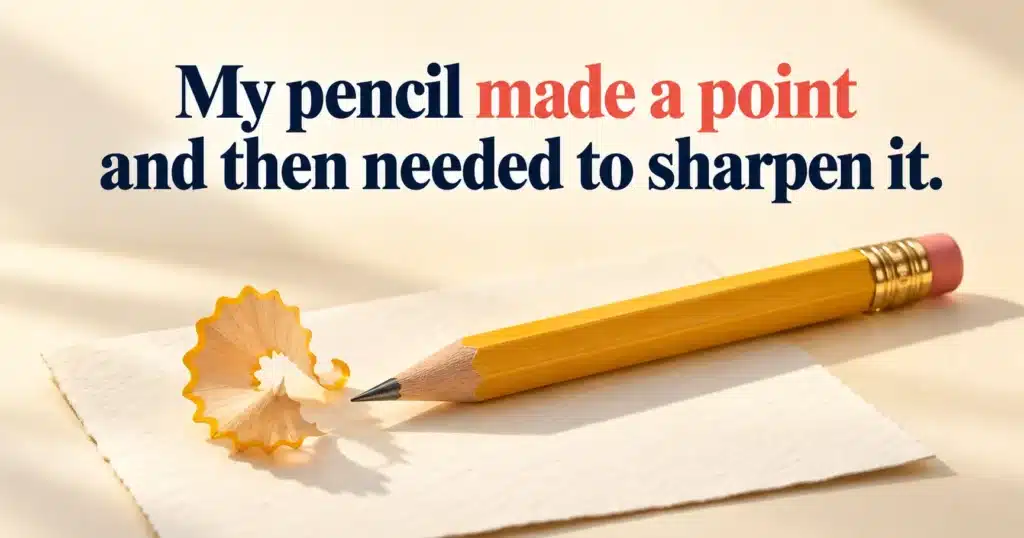
- My pencil made a point and then needed to sharpen it.
- The novel asked for space, so I left it on a shelf.
- My bookmark knows where I stopped but keeps the ending private.
- The eraser has a past it is trying to rub out.
- The notebook keeps a straight line through my worst ideas.
- The library book wanted a quiet life but kept being checked out.
- My dictionary has a word for everything and still misses the joke.
- The sticky note has commitment issues; it keeps moving.
- The ruler’s advice is measured, down to the last inch.
- My pen left a mark before it had a plan.
A library pun can work in a classroom or book-club caption, but a joke about a dictionary’s “word for everything” may feel too abstract to a very young child. Match the vocabulary to the listener. A visual pencil or bookmark joke is easier for kids to retell.
Travel, roads, and small detours
Travel one-liners should fit the actual trip. A suitcase line can accompany packing; a road sign belongs beside a drive. Avoid implying a destination or adventure the photo does not show.
- My suitcase is carrying the entire trip before we leave home.
- The road sign has strong opinions about where I should turn.
- My map and I have gone in different directions lately.
- The train platform knows how to keep people waiting in line.
- My shoes asked for a travel itinerary with more sitting.
- The gas station has fueled another conversation about snacks.
- The hotel key has a very narrow idea of access.
- The elevator is moving up without changing its address.
- The highway has a long story and no chapter breaks.
- My backpack is packed with ideas and one forgotten charger.
If a line is for a caption, check the image first. A hotel key joke under a mountain photo feels arbitrary. In a spoken conversation, a small detail from the trip is often funnier than a generic “travel light” pun. The wordplay can be a closer to a real story.
Work-safe wordplay for a casual chat
A workplace pun should not hide a deadline or target a person. These lines use office objects and familiar small frustrations.
- The spreadsheet wants to be treated as more than a collection of cells.
- My inbox is overflowing with opportunities to hit reply later.
- The printer produced a strong argument for taking a break.
- My desk chair supports me even when the meeting does not.
- The whiteboard has a clean slate until our first idea arrives.
- The calendar has dates but no time for small talk.
- My keyboard is under a lot of pressure from the deadlines.
- The paperclip is holding the project together in its own mind.
- The coffee mug has requested a standing invitation to every meeting.
- The stapler got attached to the document and took it personally.
Do not send a pun in an urgent channel where a teammate is waiting for a clear answer. In a casual thread, one line is enough. If you are writing a longer note, say the useful thing first, then add the joke if it fits. Humor is a small extra, not a replacement for information.
Pets and backyard scenes
An animal joke can borrow a familiar behavior without pretending to teach a fact about the species. These work best with a photo or a friend who already knows the pet.
- My dog called a meeting; the agenda is another walk.
- The cat has a strong position on whose chair this is.
- The squirrel has been investing heavily in the backyard.
- My goldfish makes the same lap look like a new idea each time.
- The bird feeder is hosting a very crowded breakfast service.
- The rabbit left the garden discussion hopping mad.
- My dog has a nose for trouble and a schedule for naps.
- The cat’s review of my plan was a long, silent stare.
- The backyard hose is under pressure to keep the plants happy.
- The owl on the fence seemed to have a lot of questions.
A pet caption can be more personal with a name or habit. “Milo called a meeting about a walk” belongs to a real dog; a generic line can be used by anyone. Avoid claiming the pet “loves” or “hates” something the photograph cannot show if the line is meant to be an observation.
Weather and seasons without a forecast lecture
Weather provides pressure, clouds, rain, sunshine, and wind. The line can be playful while any important weather information remains separate and clear.
- The umbrella opens up only when the sky gets difficult.
- My sunglasses are optimistic about today’s bright idea.
- The raincoat has a covered position on the forecast.
- The cloud asked for space and took up the entire sky.
- The wind has been moving things without a meeting invite.
- The snowman is taking this cold spell personally.
- My boots have a grounded view of the storm.
- The sun made a brief appearance and stole the whole scene.
- The puddle reflects on every bad decision the sidewalk makes.
- The forecast and my hair have different plans for the afternoon.
A weather pun can fit a photo of rain or a text about a changed picnic, but it should not obscure a safety message. If the conditions affect plans, state the change plainly. Add a joke afterward only if the situation is mild and the audience has room for it.
Tiny social captions with one job
These are compact enough for a picture or a quick message. The photo should supply context; the line should not need a second paragraph to explain itself.
- Current status: under a blanket and over the calendar.
- The coffee and I have reached a warm agreement.
- My weekend has applied for an extension.
- This book and I are on the same page for once.
- The plant is growing on me, one leaf at a time.
- The cake has a slice of my attention.
- My suitcase is ready; the rest of the plan is still boarding.
- The dog is walking me through today’s schedule.
- My desk is organized in theory and adventurous in practice.
- The view has me looking for a longer pause.
A caption is not a stand-alone stage joke if the image is essential. That is fine. A good one-liner can use the photograph as its opening clause. If readers cannot tell why the pun belongs to the picture, choose another line or write a simpler description.
Put the turn where the ear expects it
A one-liner has little space, so the final word matters. Consider “The paperclip, which has always held my documents together, is becoming emotionally attached to this project.” The payoff arrives after a long detour. “The paperclip got attached to the project” is shorter and clearer, though it may need a fresh scene to stand out. Put the double meaning close to the end and cut explanation that follows it.
Start with an object or situation that belongs to the audience. A spreadsheet line works in an office; a lunchbox line works for a child; a cat’s chair dispute works for a pet owner. A pun without context can sound like a random phrase generator. A specific subject gives the reader a picture before you twist the word.
Use different mechanics across a collection. Double meaning is one; a literal interpretation of an idiom is another. A third is giving an object a tiny human complaint. If every line starts “I told my…” or ends “under pressure,” readers can predict the next one. Keep the strongest version and replace the rest. Variety is more valuable than a larger number in the title.
Read the line aloud. Some puns rely on spelling and belong in print, while a double meaning can be heard. In a conversation, leave a beat after the setup if the line contains one, then stop at the payoff. In a text, punctuation and line breaks can create that beat, but do not split a simple sentence into five dramatic messages.
Finally, do not explain a line after sharing it unless someone asks. A groan means the listener heard the turn. If there is no reaction, the moment may be wrong or the wording may be unclear. You can return to the conversation rather than trying the same line louder. One-liners work because they are light enough to leave behind.
One subject, several possible turns
A one-liner often starts with a familiar object. The trick is to avoid taking the first double meaning that comes to mind for every object. A pencil can make a point, lose its point, draw a conclusion, or change its mind with an eraser. Those are related but not identical. Picture a particular pencil: a stub used in a crossword, one sharpened before a test, or one left beside an unfinished sketch. The scene helps you choose which turn has something to say.
Try the same exercise with a kettle. The obvious word is “boiling,” but the kettle could also be impatient about a slow morning or reluctant to speak until it has warmed up. If the line is for a breakfast photo, warmth is probably more inviting than anger. In an office chat, a kettle “reaching its boiling point” might sound like a complaint about colleagues. Context shapes tone as much as vocabulary.
A suitcase offers carrying, packing, travel, wheels, and baggage. “My suitcase is carrying the whole trip” is a compact thought. A joke about “emotional baggage” may be familiar and perhaps too pointed if it is aimed at someone else. Pick the line that suits the actual image and relationship. You do not need to use every pun available to one object.
This method also prevents an article from feeling assembled by formula. When each object gets a different motive, the collection has movement: a rug asks for respect, a notebook remembers things, a hat wants attention. If all eighty objects complain about work, the audience sees the template by the third section. Variety can come from the character’s desire as much as from the subject matter.
Decide whether the line belongs on screen or aloud
A printed pun can rely on spelling. A listener cannot see a changed letter, but they can hear a double meaning. If your line depends on “thyme” looking different from “time,” use it in a caption or card. If the same sound naturally suggests both a herb and a schedule in a cooking scene, it may also work aloud. Test without showing the text: read it to someone once and ask what picture they got.
On a screen, the surrounding image does part of the work. A caption under a plant photograph can be shorter because the plant is visible. The line “It’s growing on me” is clear there, but without the picture it may sound like an ordinary opinion. That is not a defect. A caption is written for a visual partnership. Just avoid calling it a universal spoken joke when it requires the photo.
In speech, the end of the sentence should carry the turn. A long opening clause loads the listener’s memory. Start with a recognizable subject, keep the action simple, and finish before the idea becomes obvious. Let the silence after the last word do some work. If someone groans, there is no need to repeat or explain. If they miss it, return to the conversation; a pun is a small offering, not a quiz.
In a group chat, use one sentence and ordinary punctuation. Splitting a short pun into a series of messages can make a casual line feel dramatic. A card can allow a little more room, because the joke may be followed by a personal wish. The one-liner should still stand alone. Add the sincere message as a separate thought rather than stretching the punchline to include it.
A quick edit pass for a stronger collection
First, underline the word or image that makes each line work. If five jokes hinge on “pressure,” keep the most specific and change the others. Next, read the opening words. A page where every line begins “My [object]…” can become monotonous even when the punchlines differ. Vary sentence shape: an object can ask a question, make a promise, or appear in a small scene. Keep the change natural; a forced inversion is worse than a repeated opening.
Then check the implied person. A printer can have a bad day, but a coworker should not be the target of a public joke about incompetence. A cat can act like a manager in an imaginary line; a real person should not have their private habit turned into a punchline without consent. Clean humor is not just the absence of swear words. It is also attention to who carries the joke.
Finally, cut redundant explanation. The line should let a reader make the connection. If you have to add “because the word also means…” afterward, either the clue is missing or the pun is too obscure for this audience. Replace a vague subject with something visible, or choose a more familiar turn. Editing one line well is usually more valuable than adding ten lines to a list.
Build a small set for a specific use
For a birthday card, choose a line that relates to the recipient’s hobbies, then write a real wish. For a school lunch note, choose a concrete object and a short sentence the child can read easily. For a social photo, choose the visible subject instead of pasting a favorite line under an unrelated picture. For a work chat, wait until the necessary information is communicated and use a neutral object joke only if the moment suits it.
If you are speaking to a room, select two or three lines with different rhythms. One can be a literal reading of a phrase, another an object with a human motive, and another a quick observation. Do not announce that you have eighty jokes. The listener’s attention is part of the exchange. A short line followed by their response is more enjoyable than a recital with no pause.
A good personal line can start from an ordinary mishap. You spill coffee on a to-do list; the list has finally found a way to cancel your plans. You find a bookmark in the wrong book; it is on a detour. These may not be perfect on the first try. Write the real sentence first, find one second meaning, and remove the explanation. The result will sound more like your life than a stock pun.
Ten minutes to write one usable one-liner
Spend the first two minutes naming the actual scene. “The library book is overdue” is better raw material than “books are funny” because it contains a problem. List a few related words: due, return, check out, chapter, shelf. Do not force all of them into one sentence. Pick the one with the cleanest second meaning or the most interesting personality for the book.
Spend the next three minutes writing several deliberately plain versions. The book may want more time away, may pretend it has moved in, or may complain that every good visit ends with a return. One of these may become a line. Do not polish the first idea too early. A small shift in attitude can make the object feel like a character rather than a prop for a stock pun.
For the next three minutes, cut. Put the subject near the beginning and the turn near the end. Delete introductory phrases such as “I was thinking about how…” and any clause explaining the double meaning. Say it aloud. If the sentence is hard to hear in one breath, it may be two jokes fighting each other. Keep the strongest thought and save the other for a separate scene.
Use the final two minutes to test the destination. Under a photo of the book, a short line may have enough context. In a text without an image, it may need a few words of setup. In a spoken exchange, a spelling-based turn may not be heard. Decide where the line belongs rather than forcing it into every format. This tiny exercise can produce one line worth sharing; it does not have to produce ten.
A few lines with a life outside this list
These one-liners can travel in a text, but they become better when the object actually appears in a photo or conversation.
- My bookmark has excellent boundaries; it knows exactly where I stopped.
- The umbrella only opens up when the forecast gets personal.
- My desk lamp thinks every late idea is its bright idea.
- The receipt has a long memory for things I meant to forget.
- My sneakers asked the weekend for fewer errands and more sidewalks.
- The elevator is going places without leaving its address.
- The tea bag has a steep learning curve every morning.
- My shopping list keeps adding things it cannot carry.
- The houseplant wants a window seat and a less forgetful roommate.
- The pencil drew the line at writing one more reminder.
- My jacket has pockets full of plans and one old movie ticket.
- The mirror and I agree that the hat is doing too much.
- My calendar keeps promising space and then inviting Monday.
- The library card leads a quiet but well-traveled life.
- The paperclip joined the team for the attachment opportunities.
- My backpack says this trip has too many “just in case” items.
- The window has a clear view and no interest in office gossip.
- My phone charger believes in second chances at 2 percent.
- The bread knife has an edge but uses it only at breakfast.
- My slippers have strong views on leaving the house before coffee.
The trick is to keep the line self-contained. If you have to explain the object or the second meaning in another sentence, it belongs in a short story instead. A one-liner should leave the reader with an image and a turn, not an assignment.
A line that looks perfect in a draft can sound crowded aloud. Read it once, then remove the phrase you would naturally skip while speaking. Most one-liners improve when the final word gets a little more space.
Frequently asked questions
What is a one-liner pun?
It is a single sentence that uses a word or phrase in two senses, a similar sound, or a playful literal reading. The setup and payoff are both inside the line. A good one can be understood without a long explanation.
How do I make a pun funnier?
Give it a specific subject and put the turn near the end. A familiar object or small situation helps the listener picture the setup. Remove any sentence that explains the double meaning after the punchline, then read the line aloud.
Are one-liner puns good for captions?
Yes, when the photograph supplies context. A suitcase line fits a packing photo; a kettle line fits a kitchen scene. If the image and line have no connection, the pun can feel pasted on. One line is usually enough.
Can I use these puns at work?
Choose clean jokes about objects or minor shared inconveniences and send them in a casual moment. Do not hide a task or deadline inside wordplay. Avoid making a coworker the subject of a joke unless you know it is welcome and appropriate.
Why do some puns only work in writing?
An altered spelling may reveal the double meaning visually, while a listener hears an ordinary word. Printed captions and cards can support those, but spoken jokes are stronger when both meanings can be heard naturally.
What is the difference between a pun and a joke?
A pun depends on language with two meanings or similar sounds. A joke can use a story, surprise, character, or reversal without wordplay. A one-liner pun is both a pun and a very short joke when it has a clear comic turn.
How many puns should I tell in a row?
Start with one. If the listener enjoys it or adds another, continue. A long series can make the mechanism predictable and crowd the conversation. A groan can be an affectionate response, but it is not an invitation to monopolize the room.
How can I avoid copying a familiar line?
Start from a real situation and write the observation first. Find one double meaning that belongs to it, then change the scene or payoff if it sounds like a line you already know. Replacing only the object in a classic joke is not much of a new joke.
Give the line room to land
A quick pun needs a recognizable setup, a clean turn, and a moment where someone might enjoy hearing it. Use a food line by the plate, a pet line under a pet photo, and an office line only when the thread has room for humor. The best one-liners are short because every extra word has been tested. Choose a few you can say naturally, share one at a time, and let the groan be part of the fun.

