
A child does not need to stay awake until midnight to enjoy a New Year’s joke. A paper hat, a calendar with a blank page, or a balloon practicing its count can make an early family celebration feel like its own event. These clean Good New Year’s jokes are written for children to hear, guess, and retell, including first-week-back lines for a school lunch note or classroom joke jar. The questions use familiar objects instead of adult resolutions or party customs. Let a child invent a different answer if they want; sharing the joke is often funnier than arriving at the printed punchline.
Countdown questions for little comedians
A visible clock or a pretend countdown can help kids understand these lines. Ask the question, pause, and let them try an answer before reading yours.
- Why did the clock bring sneakers to the party? It was ready to run out the old year.
- What did ten say to nine during the countdown? “You are next.”
- Why did the timer wear a hat? It wanted to look good when time was up.
- What did the minute hand do at midnight? It waved to the next day.
- Why did the party clock feel proud? Everybody was watching its big moment.
- What did the bell say when the year changed? “I am ringing in a new idea.”
- Why did the calendar look at the clock? It wanted to know when to turn.
- What did the noisemaker tell the timer? “I am ready when you are.”
- Why did the second hand move so fast? It had places to be.
- What did the party hat do at twelve? It stayed on top of the celebration.
The last ten seconds of a party are for counting together, not for a long joke. Tell these while decorating, before a family countdown, or the next morning. If a younger child cannot stay awake until midnight, a pretend early countdown can still be fun; the joke does not require a particular hour.
Calendar jokes for a school morning
A classroom calendar gives children a prop they can point to. The joke can lead into an ordinary activity: marking a date, planning a class event, or writing a short wish.
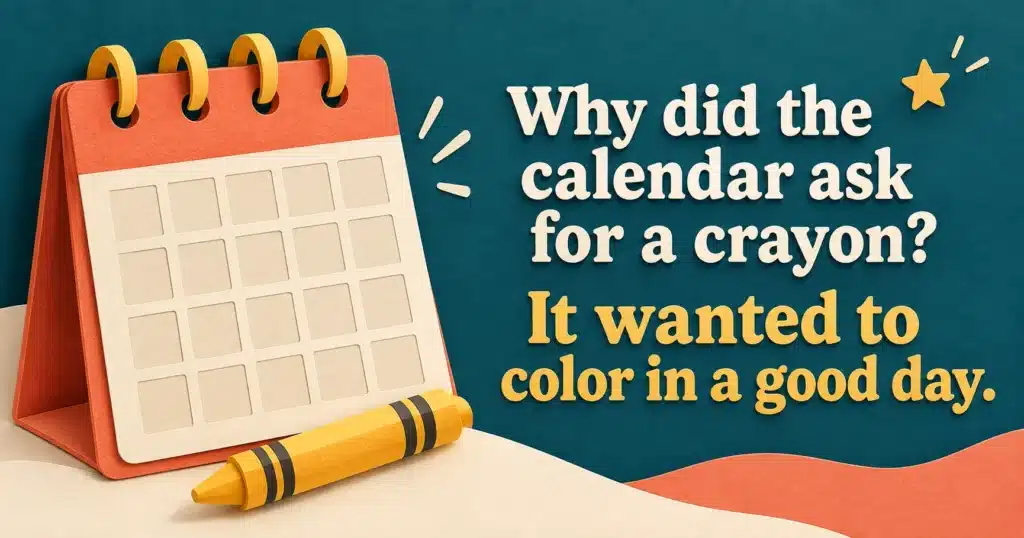
- Why did the calendar ask for a crayon? It wanted to color in a good day.
- What did January say when it opened the door? “I have a lot of room.”
- Why did the calendar bring a pencil? It liked plans that could change.
- What did the first page tell the last page? “Thanks for the stories.”
- Why did the planner visit the classroom? It wanted to learn the schedule.
- What did Monday ask the new calendar? “Are we doing this already?”
- Why did the calendar smile at the lunchbox? A good date was on the way.
- What did the blank square say? “I am open to ideas.”
- Why did the eraser like January? It had room to try again.
- What did the new page ask the old one? “What should I remember?”
A teacher can invite students to supply alternative answers without turning it into a competition. A child might say the calendar brought a crayon because it was bored, which is a perfectly good cartoon thought. The joke is a prompt for wordplay and imagination, not an item with one correct response.
Winter-break jokes for the family table
These lines use familiar objects: slippers, snacks, coats, and a quiet morning. They do not assume every family travels or throws a party.
- Why did the slippers love the new year? They got the first steps.
- What did the blanket say on January 1? “I still have you covered.”
- Why did the cookie ask for a new plate? It wanted a fresh start.
- What did the winter coat tell the party hat? “You look cold up there.”
- Why did the couch bring a book? It planned a peaceful first chapter.
- What did the popcorn say after the movie? “That was a good ending.”
- Why did the snow boot look ahead? It expected a few more steps.
- What did the breakfast bowl say? “I am ready for the first spoonful.”
- Why did the scarf stay at the party? It was wrapped up in the fun.
- What did the pillow ask the clock? “Can we start the year a little later?”
A family table may include preschoolers and teens. Let the younger child enjoy the visible prop and the older one add a drier punchline. The point is a shared turn, not proof that everyone laughed at exactly the same syllable. If the conversation has moved to something important, put the joke away.
Party decorations with personalities
Balloons, hats, streamers, and confetti already look as though they belong in a cartoon. These short setups give each decoration a tiny plan.
- Why did the streamer cross the room? It wanted to hang with everybody.
- What did the confetti say when it fell? “I have arrived.”
- Why did the balloon ask for a bigger room? It wanted space to rise.
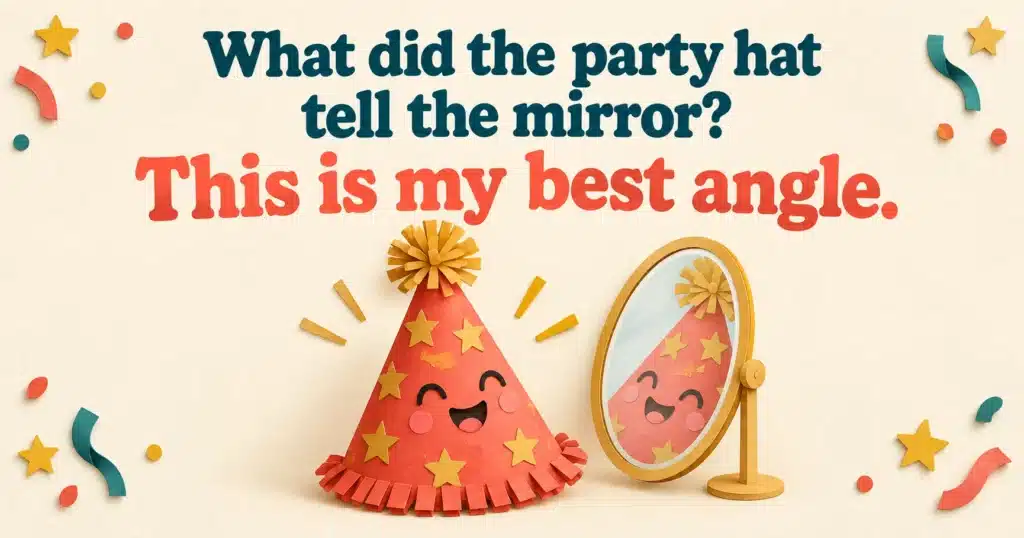
- What did the party hat tell the mirror? “This is my best angle.”
- Why did the banner bring tape? It wanted to stick around.
- What did the noisemaker ask before the countdown? “Is it my time yet?”
- Why did the paper star sit by the window? It liked a bright view.
- What did the confetti do after the party? It moved under the couch.
- Why did the streamer need help? It got tangled in its own plans.
- What did the balloon say to the party hat? “You are a little pointed.”
A child’s joke about decorations can turn into an art activity. Draw a party hat with a speech bubble and ask what it would say when the party ends. The best line may come from the child, and it does not need to be a pun. A silly personality is enough.
Lunch notes for the first week back
A lunchbox note should be short enough to read at a glance. A joke can sit beside an encouraging line, but it should not replace a reassuring message if school feels hard that day.
- Why did the pencil like January? It had new lines to draw.
- What did the lunchbox say on the first day back? “I have been practicing.”
- Why did the backpack bring a calendar? It wanted to know where it was going.
- What did the apple tell the sandwich? “Let us make this a good lunch.”
- Why did the notebook smile? Its first page was ready.
- What did the crayon say to the new year? “Pick a color.”
- Why did the ruler walk slowly? It was measuring the first step.
- What did the eraser say after a mistake? “We can try another line.”
- Why did the water bottle bring a friend? It did not want to be the only one at lunch.
- What did the sticker say to the notebook? “I am glad we met.”
Add “I will see you after school” or another true detail when a child needs reassurance. Do not promise that the entire year will be perfect. A small, readable joke and a dependable pickup plan can coexist on one slip of paper.
Resolution jokes children can understand
For kids, a resolution can be described simply as something a person hopes to practice. These jokes keep the subject gentle and do not ask a child to make a grand promise.
- What did the pencil resolve to do? Keep making good points.
- Why did the shoe make a plan? It wanted to take more walks.
- What did the book hope for? More time off the shelf.
- Why did the plant choose a goal? It wanted to grow toward the window.
- What did the dog resolve to do? Ask for one more walk, politely.
- Why did the lunchbox make a list? It wanted better snack ideas.
- What did the clock practice? Giving everybody a little time.
- Why did the ball set a goal? It wanted to bounce back.
- What did the blanket promise? To keep giving warm welcomes.
- Why did the kite make a plan? It hoped for a windy afternoon.
After a joke, ask about a small thing the child wants to try if they are interested. A goal can be learning a game, drawing a picture, or reading a book. Avoid treating the joke as a lesson about self-improvement. Children can enjoy a new calendar without becoming a different person.
Silly dialogues to read with two voices
A back-and-forth gives siblings or classmates a part to play. Read slowly enough for the second voice to land, then switch roles for the next one.
- Calendar: “I am new here.” Clock: “I will show you around.”
- Party hat: “I am ready.” Balloon: “You are already ahead of me.”
- Pencil: “What should we do first?” Notebook: “Make a mark.”
- Slipper: “Big plans today?” Couch: “Let us start small.”
- Confetti: “Where is everybody going?” Broom: “I was about to ask you.”
- Lunchbox: “What is new?” Sandwich: “Same filling, fresh day.”
- Banner: “Will they read us?” Streamer: “I hope they have time.”
- Clock: “It is almost midnight.” Pillow: “I had other plans.”
- Snow boot: “Ready for a walk?” Scarf: “I am wrapped up in it.”
- Crayon: “Which page?” Calendar: “The one we are on.”
These dialogues are easy to extend: ask what the broom says back to the confetti, or what the notebook wants to write. If the game becomes a story, let it. The printed lines are prompts for play, not a script the group has to finish exactly.
Quick endings for a family countdown
These are one-line jokes or wishes that a child can say before the last ten seconds or after everyone cheers. Keep the shared moment ahead of the performance.
- The year is changing its page; I hope we keep reading together.
- The party hat says we have reached the top of the night.
- The clock has done its job; now it is our turn to cheer.
- The calendar brought new squares for more family days.
- The snacks are ready for the next chapter.
- The confetti has plans to visit every corner of the room.
- The new year has arrived without asking for directions.
- The first minute is small enough to share with everyone here.
- The balloon is looking up to the year ahead.
- The couch has already planned the first quiet morning.
A family countdown can happen before midnight if that fits the children. Do not claim the joke proves anything about the coming year. The line should give everybody a chance to smile and keep celebrating. A hug or a familiar song may be the better ending.
Let children tell the punchline their own way
A child-friendly joke needs a clear image and a simple turn. A clock, balloon, calendar, or mitten is easy to imagine. Ask the question slowly, then let the child answer. If they invent a new answer, you can laugh with them even when it is not the one on the page. The joke is a prompt for play, not a memory exam. That matters especially at a family celebration where younger children may be staying awake later than usual.
Try a two-person reading game. One person reads the questions, and the other invents answers before hearing the printed ones. Swap roles after three jokes. This gives shy children a choice: they can read, guess, or simply listen. A child who prefers drawing can illustrate a calendar with a funny expression or a party hat that has gone to bed. The jokes become material for a shared activity rather than a performance in front of adults.
At school, avoid assuming every student stayed up until midnight or celebrated the same holiday. A first-week-back joke can be about a new page or a winter coat. Invite students to tell a joke about a familiar object without asking them to describe their family’s plans. The setting remains inclusive when no one has to reveal private traditions to participate.
Keep the vocabulary concrete. “Resolution” may need a plain explanation for a younger listener: a small plan someone makes for the year. A joke about a planner overbooking itself may be funny to adults but too abstract for a six-year-old. A balloon practicing counting to ten gives the child something they can imitate. If you need to explain several words before the punchline, save that joke for older children.
Make an early countdown feel like a real celebration
An early countdown works best when the time is openly chosen. Tell children, “We are counting down to our family celebration at eight,” rather than pretending the clock says midnight. They can decorate a paper chain, choose a song, or make a wish for a fun activity together. A joke can introduce each step, but the shared action makes the evening memorable.
Put three short jokes on cards near the snacks. A child can pick one when the group has a quiet minute. Do not require everyone to tell a joke before dessert; a voluntary game feels better. A paper hat can become the host of the questions, which lets a child speak through a silly object if they feel shy. The same object can later appear in a drawing or photo.
After the count, invite one real wish that is small and possible: a picnic, a library visit, more time building together. No one needs to announce a self-improvement plan. A cheerful joke about the calendar’s first page can lead into the idea that a year contains many chances for ordinary good days. Keep the mood light and let bedtime arrive without making it the punchline.
Write a joke together from an ordinary object
Choose a thing in the room. A paper cup might want a party hat, a mitten might offer a high five, or a calendar might ask for a fresh drawing. Ask the child what the object wants. Then ask what would surprise us about the way it gets that wish. A cup with its own hat is a silly picture even before anyone thinks of a pun.
Write a question that names the object but holds back the surprise: “Why did the cup put on a hat?” The answer can be playful and direct: “It wanted to dress up too.” Say both parts aloud. If the answer is hard to remember, shorten it. For young children, a clear silly picture often works better than a sound-alike word that only makes sense on paper.
Now try the same object in a different setting. A cup on the party table has one goal; a cup in a lunchbox has another. A calendar at home might want more Saturdays; a calendar in class might want a new drawing. Changing the setting gives the child a way to invent a new joke rather than reciting a standard one. Praise the observation, including an answer that is strange but funny to them.
When a joke belongs in a note or card
A lunchbox note has very little space. Pick one question and put the answer immediately below it so the child can enjoy it without asking another student for help. Add a simple sentence that is actually from you: “Have a good first day back.” A joke can make the note light, but it should not replace the affection or encouragement you meant to send.
A classroom card can contain one joke and a drawing. Avoid promising that the new year will be perfect. Children understand that some days are difficult. A wish for curiosity, rest, or time with friends is both more believable and more useful. Keep the humor about an object rather than a classmate’s mistake or a family’s schedule.
If you post a child’s performance or joke online, consider the child’s privacy and comfort. A written joke can be shared without a face or name. At home, the best reward is often a laugh from the people in the room, not a public audience. Let the child decide whether to tell the next one.
A low-pressure joke station for children
Put a few printed questions on a table with pencils and blank cards. Children can read a joke, draw its character, or invent a new answer. A balloon can have a face; a calendar can wear pajamas; a mitten can offer a high five. Let them choose what to do. Some children enjoy performing, while others prefer to watch or draw. Participation can look different without being less valuable.
Keep the written lines short and large enough to read easily. For younger children, pair the question with a simple picture. If the answer depends on spelling, choose another joke for the spoken station. A child should be able to enjoy the turn after hearing it once. An adult can help read without correcting every pause or changed word; the child’s invented version may be funnier than the printed one.
A small early countdown can end the activity. Ask a volunteer to choose one joke before everyone counts together. Once the countdown begins, let the group do it. Afterward, children can take home their cards if they want. The goal is a shared moment, not a contest for the loudest or cleverest joke.
A classroom’s first-week joke jar
Write one question on each slip. Children can draw an answer, guess aloud, or make up a better punchline. These use objects they may see at school.
- Why did the new notebook smile? It had room for everybody’s ideas.
- What did the pencil tell the calendar? “We can start on a fresh line.”
- Why did the backpack get up early? It wanted the best hook.
- What did the ruler hope for this year? More room to grow.
- Why did the lunchbox bring a party hat? It missed the celebration.
- What did the eraser say to a new page? “Let’s try again if we need to.”
- Why was the library book excited? It had a new reader to meet.
- What did the classroom clock practice? Counting down to recess.
- Why did the mitten sit beside the pencil? It wanted to lend a hand.
- What did the paper chain say to the class? “We’re all connected.”
- Why did the crayons like January? There were new pictures to make.
- What did the chair promise the new student? A place to sit.
- Why did the globe turn slowly? It wanted to show everyone the view.
- What did the bulletin board ask for? A bright new idea.
- Why did the school bell sound cheerful? It had people to welcome back.
- What did the glue stick say to the craft paper? “Let’s stay together.”
- Why did the winter coat wait by the door? It knew recess was coming.
- What did the calendar want after the break? A drawing for its first page.
- Why did the marker make a bold entrance? It forgot to put its cap on.
- What did the desk tell the notebook? “You can work here.”
The teacher can read one at the start of a day and leave the jar alone. Some children will want to invent a joke; others will just enjoy hearing it. No one has to explain how their family celebrated New Year’s Eve.
The joke jar can stay in the classroom for the whole first week. Let children put in a new question when they notice a funny detail, even if it has nothing to do with midnight. A marker without a cap or a backpack too full for its hook can become a tiny character. Reading one slip each morning keeps the game light. The point is to give the children a chance to surprise each other, not to make New Year’s celebrations a test of who has the best family story.
Frequently asked questions
What is a good New Years joke for a child?
Choose a short question about a familiar object, such as a clock, party hat, calendar, or lunchbox. Let the child guess before sharing the answer. A visual or easy-to-repeat joke works better than a complicated adult reference.
Can a classroom use New Year jokes?
Yes, as a brief warm-up or writing prompt. Students can invent alternative endings, draw a joke character, or practice a short dialogue. Keep the activity age-appropriate and separate from instructions the class needs to follow.
Are these jokes suitable for preschoolers?
Some are, especially those involving hats, balloons, crayons, and blankets. A preschooler may enjoy the picture more than the wordplay. Read one aloud, use a prop, and do not expect them to understand every double meaning.
What should I write in a lunchbox note after winter break?
One short joke plus a real reassurance works well. “I will see you after school” may matter more than the punchline on a nervous first day back. Keep the note readable and suited to what the child is experiencing.
How can kids write their own New Year jokes?
Pick a visible party or school object, list what it normally does, and give it a small goal for the new year. A clock might want more time; a lunchbox might want a new snack. Keep the answer to one sentence and let classmates suggest different endings.
Do New Year jokes have to mention resolutions?
No. Clocks, calendars, winter mornings, party decorations, and the first day back at school provide plenty of material. A resolution joke can be gentle, but no child needs a self-improvement assignment to enjoy the holiday.
Should I tell these jokes at midnight?
Tell one before the final countdown or afterward. The ten seconds themselves are for everyone to count and cheer. Families can also hold an earlier countdown if that suits the children; the joke works at either time.
What if a child invents a different answer?
Enjoy it. The alternate ending may be funnier than the printed line. The point is to play with words and ideas together, not to grade a child on remembering a predetermined punchline.
Let the kids take the next turn
A clean New Year joke can brighten a family table, a classroom morning, or a lunch note because it invites another answer. Choose a familiar object, keep the setup brief, and give children time to guess. A clock, hat, or calendar can become a character for a moment without making another person the target. When the child invents a new ending, follow it. The shared game is more memorable than a perfect punchline read from a list.

